
Morondava - Women's Section

Just when I think I have seen the worst, another scenario hits me between the eyes.
In 2014 while visiting Morondava Prison, I learned that the toilet in the women’s chamber overflows into their sleeping quarters, and if the doors are locked, the women and babies are literally sleeping in human waste. The chamber is grossly overcrowded, despite having two-tier bunks. A third of the women sleep on the floor.


I asked how they decide who sleeps where. In their tight, little community, they have come to a consensus. The older vulnerable women and young girls who aren’t used to hardship are allotted the more “comfortable” hard wood bunks. Tougher middle-aged women with babies sleep on the floor. However, some of the young girls volunteer to trade places with the moms. It struck me that these kids mature quickly under such harsh conditions. Goodness blooms in unexpected places.
The women showed me the broken shower, despicable toilets, and useless faucets. When asked about their priorities, they voiced the same litany of needs I hear in every prison I visit: empty stomachs, not enough food, only one meal a day, only manioc, no vegetables, no beans, only manioc, my stomach hurts we are so hungry, we are getting sick, help us. Their cries echo between the dingy cement walls, unheeded.
We at Moringa are at a loss how to approach the epidemic overall prison hunger. The country is so poor that even the roads between major cities are a series of muddy potholes. Seventy percent of the population is without electricity. It is unrealistic at this point to expect the government to be able to come up with two meals a day. The money just isn’t there. Even the one meal they supply is barely edible.
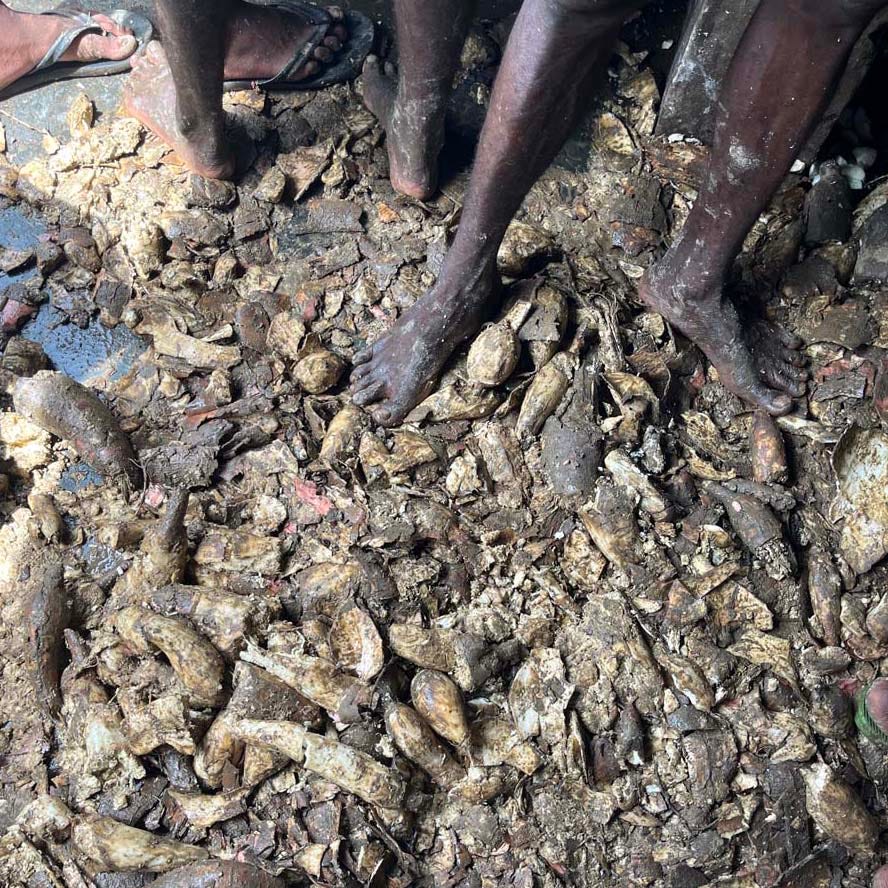
Below is a photo of prison lunch. Moldy manioc being collected and boiled.
Although each prison is endowed with a large area of government-owned farmland, these prison farms are largely undeveloped and produce little food. We are intervening in two prison farms on a trial basis and have provided funds for plowing and planting. We are looking into applying for grants to drill wells for irrigation. Prisoners on conditional release already live on these farms, and the idea is that they grow enough food for themselves and the prisons. So far, we haven’t seen much success from this model. We are looking for economic ways to make this work and to ensure accountability..
In Morondava Prison, I asked for volunteers to tell me their stories. One young teenage girl spoke up, a short clip below. During the interview, older women were prompting her in the background, incensed by her situation and upset that she had been freed and ended up right back in prison. She first stole money from her employer. He hadn’t paid her for months and she was basically working as slave labor. He accused her of theft, undoubtedly having paid a little something to the police. After several months in prison she was released without a means to get home, stole money for bus fare, and was caught again.
In the audio below you can hear her soft voice. I remember her as just a young teenager.
“What is your name?”
“Up to what class have you studied?”
“5th grade”
“Do you plan to continue your studies?”
“My parents are poor. They can’t afford to send me to school.”
“So you have to work. “
“My parents live far away. They can’t send me money for food. I am trying to survive here. I am asking for help.”
“What kind of help do you need?”
“Food.”
In another prison, an official asked me to cover the bus fare for a soon-to-be released kid. I gave him the money and found out later that he had pocketed the cash. I can understand it in a way, that these men and women in uniform are underpaid and under-appreciated. However, taking money from prisoners? It can really be demoralizing..
We have just about finished renovating the septic system and floors in Morondava Prison and are awaiting funds to replace the roofs in the men’s chambers. These are times when hope and happiness radiates into the prison walls. Toilets get fixed, proper septic systems are installed, leaky roofs replaced, suffocating chambers are ventilated, and we experience prison women breaking into song with the words,
” We are blessed, thank you God.”
Next post is “Good News Only.” I will show you the amazing renovation work that Maoly, Francel and his team have accomplished in Morondava Prison.
Many thanks to those who support this work.
We welcome your donations . Thank you being an integral part of this endeavor. Without you, this work would not be possible.
Moringa Inc is a registered non-profit charitable company with tax exempt status under Section 501(c)(3).
There are three ways to donate.
The Subscribe Button will lead you to the donation page where you are given several options. It doesn’t matter if you are on the Subscriber List or not. Substack sends your donations to our tax-exempt Moringa Inc account. In turn, we will send your donations directly to Moringa Madagascar Association based on current projects that are being implemented.
If you prefer sending by check, please send checks in the name of: Moringa Inc to our U.S. based Director:
Janet Midthun
4400 36th Ave #114
Mpls. Mn 55422
You can also donate through the Reformed Church in America (RCA). This link goes directly to the Madagascar Prison Relief subsection of Global Mission. They send your donations directly to Moringa Madagascar Association, based on current projects that are running.
I subscribed and am a founding member.
I love the singing voices! Such good writing! I see it. I feel it. All senses involved. What sacred work.