
Sanitizing Sanitation
Morondava's Renovation

You know how sometimes we remember the strangest details from childhood, how little images pop into our minds out of the blue? One little anecdote, whether true or not my adult self can’t say, is from when I was about ten. It was said that in Chinese labor camps, prisoners were forced to carry buckets of their poop to the fields every morning and spread it on top of the soil as fertilizer. I remember thinking that dogs can poop anywhere they please with no shame, but me, carrying my own poop in front of everyone to an open dumping ground? No, never! The thought of eating vegetables grown with human poop gagged me.
Poop is a rather taboo subject. We wonder why anyone would choose to become a plumber and fix blocked toilets, or a gastroenterologist and do colonoscopies. Toilets have doors with locks for a reason. We walk into a bathroom and come out again, pretending that nothing just happened in there. Behind us wafts that sickly-sweet scent of toilet bowl cleaner and soap. And why is it called a bathroom anyway when we’re not even taking a bath? We excuse ourselves to go to the “little girl’s room”, the “powder room” to take care of a “little stomach issue”. On the opposite extreme, movie clichés show adults fainting from the smell of newborn diapers. This is supposed to be funny.
I too am guilty of using euphemisms for unpleasant situations. I speak of doing “sanitation renovation” in the prisons. There is nothing sanitary about poop– even flowing from shiny white new toilets, down newly covered canals and stored in freshly cemented and enlarged septic tanks. Poop causes diseases. As kids, we weren’t allowed to walk in the rice paddies, because the “soko-ratsy” (bad worms or bilharzia) larvae would travel from human poop into your feet, up your blood stream and crawl into your liver or even your brain. Every six months, the boarding school kids were forced to swallow a big spoonful of white globby, slimy worm poison because it was assumed we all had worms, caught from from poop bugs while playing barefoot outside.
Our family lived in a St Paul Minnesota house one summer. The bathroom was painted a soft baby pink. Plastic flowers, twist-tied into a bouquet, were stuck to the wall next to the sink with mounting tape. On the opposite wall hung a contemplative Bible verse printed on construction paper attached to a Styrofoam backing, rick rack glued around the edge to mimic a picture frame. The toilet paper roll was topped by a prairie girl doll, complete with a ruffled bonnet and lacy petticoat. Encasing the toilet lid was an elasticized cover resembling a fluffy shower cap. A matching pink rug placed right in front of the toilet completed the ensemble.
When you visit Madagascar prisons, there is no pretense about poop. There is nothing funny about poop. When not managed properly in these situations of gross over-crowding, it quickly becomes a human disaster.
Imagine living in such an environment with no working toilets – the septic tank overflowing onto the grounds and streaming into your sleeping quarters during rainy season, the toilets so full that teams of prisoners scoop out collective human waste daily with small shovels into buckets, and empty them out behind the toilet block. Imagine being told “don’t walk there”, because a boy had just pooped on the ground next to the toilet shack and covered it with dirt like a cat because the toilets are so overflowing he can’t stand to go near them. Imagine pooping in the shower stalls because the toilets are blocked. Imagine the smells of a hundred prisoners using one unflushable toilet, and then locked together into small quarters for 12 hours a day.


I was initially asked to work in the Malagasy prisons to teach life skills and introduce designs for potential income generation. Being hit in the face by this sanitation disaster, I quickly changed course. How can humans allow others to live like this?
Here it an excerpt from a report I wrote when visiting Antalaha Prison in 2023:
“It didn’t take me long to realize that there was a harsh disconnect between the reality of this subhuman enclosure and our somewhat naive plans for on-the-job training programs. The reek of urine and sewage assaulted my sense of smell. A dizzying flurry of questions and feelings swept over me. What IS this place? I peeked through the fence at the men’s section. All I could see was a mass of semi-naked human shapes. I wanted to look and I didn’t want to look at the same time. I peeked into the boy’s toilet stalls. The toilets were backed up with overflowing watery excrement where the kids had placed bricks like stepping stones. The ‘shower’ was also used for defecation, but without ample water, the waste just piled up.”


Today, when checking out different prisons, the first place I ask to see are the toilets. The guards are resistant at first, but then comply. Tulear was the first place where I encountered prisoners manually emptying toilets; my childhood Chinese labor camp nightmare had come true. I subsequently learned that this prison was just one of many where inmates must shovel out the toilets on a regular basis.
A large part of our initial budget goes into renovating the septic systems in the prisons. First, the canals must be rebuilt and redirected into a properly constructed holding tank.


The old septic tanks need to be manually emptied, the cavity enlarged
and cemented in.


The small, leaking, PVC pipes from the toilets to the canals need to be replaced with large gauge pipes to handle the number of prisoners.


Next is water. Many prisons don’t even have enough water for drinking, much less for manually flushing water into the toilets. Before the septic system can work, the water system needs to be addressed. This might include purchasing new submersible pumps, digging wells and constructing water towers (so far we haven’t been able to afford this option), replacing leaky pipes and more. The pumps require electricity. In Antalaha, the grid ran for approximately 2 hours during the day, and 3 hours at night. Despite these setbacks, the septic systems are now a whole lot better after our renovations.
Our team has all become rather accustomed to discussing the subject. The other day we were passing a set of showers,
“Maoly, they are pooping in the shower stalls.”
“No Tamara, that’s just a yellow plastic bag.”
I am so impressed with our team members for doing this filthy, disgusting work without complaining. If any one of you wish to thank our team for cleaning out the sewers and septic tanks before rebuilding and cementing, please send me a note and I’ll pass it along. One day Francel came to me, “Tamar, today we have finished a really nasty job. How about beers for us all?” I reached into my wallet.
In Morondava, remember me telling you that the boys sleep on a wet floor during the rainy season, and the women sleep in overflowing toilet waste? Now the women and children are sleeping on a dry floor even when it rains, because the roofs are replaced and the septic system repaired. And not only that, we gave the boys a brand new shiny cement floor.
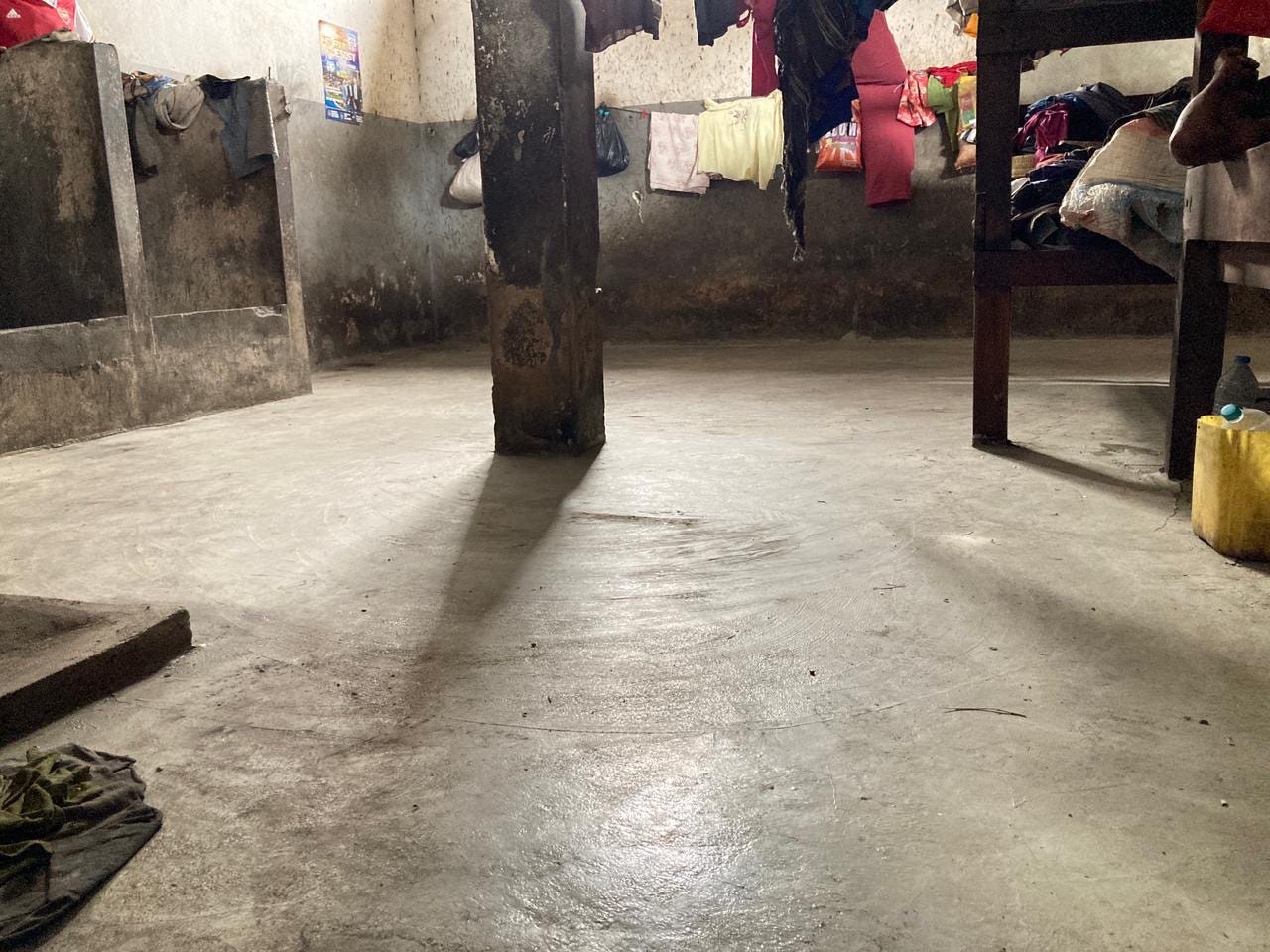
I promised you a “good news letter” last time. While our team was working on the canals and holding tanks, the Prison Director asked if we would “please please” reinforce the wall of an important building that was ready to collapse. So we did.

Here are a few more before and after photos of renovated septic and water supply systems.


When I was a child, my nighttime prayer was, “Thank you Jesus for my Mommy’s soft big tummy which is so cozy when I sit on her lap.”
Today it is, “Thank you Jesus I don’t have to sleep in poop. Amen.”
We are running low on funds and would appreciate any help. Morondava and Antalaha Prisons still need roofs replaced and ventilators installed. Anivomamo, Tsiafay, Fort Dauphin and Ambovombe prisons are in bad shape. I plan to check out Tulear Prison and Diego Prison in a month’s time.
Thank you for your loving kindness to the prisoners of Madagascar.
We welcome your donations Without you, this work would not be possible.
Moringa Inc is registered as a non-profit charitable company with tax exempt status under Section 501(c3).
You can donate by clicking the Subscribe Button, which will lead you to the donation gateway.
You can also give a one time donation directly to Chase Bank by check.
Please send CHECKS in the name of: Moringa Inc
to our U.S. based Director:
Janet Midthun
4400 36th Ave #114
Mpls. Mn 55422
I am speechless while I take this in. I am so humbled during this Lenten season to see this love with determination.